
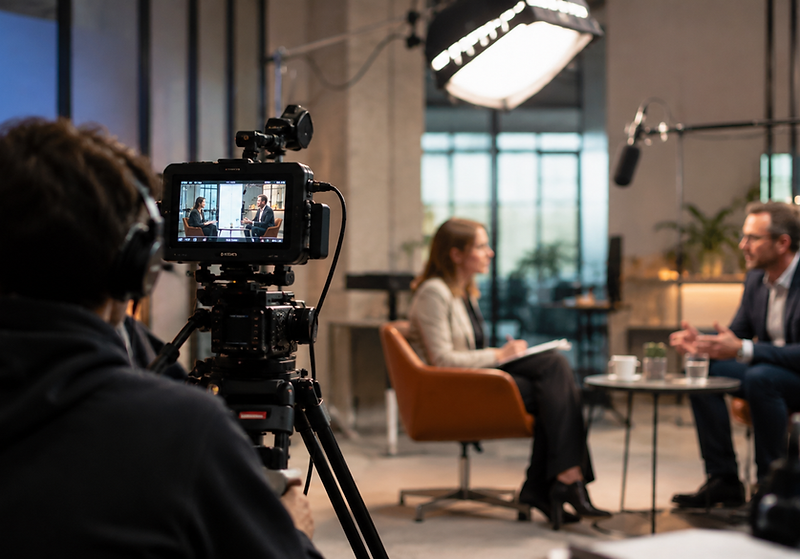
Why great video production doesn't start with the camera.
A technically perfect video isn't necessarily a great video. Discover why successful video production starts with clear objectives, an understanding of the audience and meaningful content, rather than the choice of camera.
Impressive visuals don't automatically make a message compelling. Yet video production planning often begins with technical questions. Which camera should we use? How many people do we need? Where should we film? Meanwhile, the most important question sometimes remains unanswered: what is this video actually supposed to achieve?
A technically perfect video can still miss the mark
The technical possibilities of video production have expanded enormously in recent years. Cameras have become more powerful, editing software more accessible, and professional-looking footage is no longer reserved for productions with substantial budgets. But better technology doesn't automatically lead to better communication.
A corporate video can look impressive without clearly explaining what makes an organisation different. An interview can be perfectly lit and recorded, yet run so long that its central message gets lost. A training video can be technically flawless while leaving viewers unsure what to do with the information they've received.
In situations like these, the camera is rarely the problem. The real issue lies in the decisions made before filming even begins.
The first question isn't how, but why
Every video production should ideally begin with a clearly defined objective. Is the purpose to inform, persuade, educate or inspire? Should viewers understand something, remember a particular message or actually change their behaviour?
The distinction matters more than it might initially seem. A video designed to teach employees a new safety procedure requires a very different approach from one introducing a company to potential customers. In the first case, clarity is essential. In the second, familiarity, trust and emotion may play a more significant role.
The way success is measured will also differ. A training video isn't necessarily successful because it has been watched thousands of times. What matters far more is whether the information has been understood and put into practice. Conversely, a promotional video reaching a relatively small but highly relevant audience may be more valuable than a production generating impressive viewing figures without reaching the right people.
Reach is not the same as impact.
Viewers don't care about the production equipment
When producing a video, considerable attention goes into the content, filming and technical execution. Viewers, however, only experience the finished result. They generally have no idea how many cameras were used, how many lighting setups were required or how many editing days went into the production. And they don't need to.
What matters is whether the video is relevant, easy to understand and engaging to watch. That's why the target audience deserves just as much attention as the subject itself. A specialist speaking to fellow professionals can assume a certain level of prior knowledge. The same specialist will need to explain things very differently when addressing a general audience.
The viewing context matters too. A video shown on a large screen during a conference will generally receive more focused attention than one encountered on a smartphone among countless other pieces of content. That difference affects the ideal length, visual language, use of on-screen text and how quickly the main message needs to become clear.
The same subject may therefore require entirely different production approaches depending on who will watch it and where.
More cameras don't necessarily mean better quality
In audiovisual production, there's sometimes a tendency to associate the scale of the technical setup with the quality of the result. Additional cameras, a more elaborate set, complex camera movements or extra graphics can all enhance a production. But only when they serve a clear purpose.
Take an interview with an expert. A second camera can help create a more dynamic edit, provide alternative angles or make transitions between answers smoother. But if the content hasn't been properly prepared, that extra camera won't make the interview more interesting. The same principle applies to webinars. A professional studio, multiple camera angles and a sophisticated production setup can contribute to a pleasant viewing experience. But if the presentation lacks structure or the speaker fails to engage the audience, those technical resources won't solve the underlying problem.
The right question isn't how much technology a production can accommodate, but which technology genuinely adds value. Sometimes, a straightforward recording with excellent sound, a compelling speaker and a clear structure is the most effective solution.
The value of preparation is often underestimated
A filming day is visible. There are cameras, crew members and equipment. People are working, recording and producing footage. Preparation is far less visible, yet it largely determines how efficiently that filming day will run. Good preparation goes beyond a schedule or an equipment list. It involves editorial decisions: which message should take centre stage, what information is essential, who should tell the story and which images will support it?
Knowing what to leave out is equally important. Organisations often have far more information to share than viewers can absorb in just a few minutes. The challenge isn't to fit everything into a video, but to identify what truly matters. That sometimes requires difficult choices. A message considered particularly important internally may not be especially relevant to the intended audience. And a detail discussed extensively during planning may mean very little to the eventual viewer.
Making those decisions in advance also saves time during filming and editing. Preparation isn't simply an administrative stage before the real work begins. It's an essential part of the production itself.
Even great editing can't completely rescue an unclear story
Editing is where a video production takes its final shape. The pace is established, footage is selected, unnecessary passages are removed and individual elements are brought together into a coherent whole. Good editing can significantly strengthen a story. But it can't solve everything. If essential information is missing from the footage, the message isn't sufficiently clear or the wrong questions were asked during filming, the options remain limited. This explains why a production made with relatively simple resources can sometimes be more convincing than a technically ambitious production without a clear editorial direction.
Editing isn't a substitute for a good story. It's the process that gives that story its final form.
When is a video production truly successful?
Video success is frequently assessed using visible metrics: views, reach, reactions or average watch time. These figures can be valuable, but they don't always tell the whole story. For an instructional video, the key question is whether people can correctly perform the task being demonstrated. For an internal communication video, success may be measured through understanding and engagement. In medical education, knowledge transfer may matter more than the total number of viewers.
That's why evaluating a video production actually begins before production itself. Defining what a video should achieve from the outset makes it easier to assess whether that objective has been met. Without a clear objective, evaluation often comes down to subjective impressions: the video looks good, the editing is polished and the footage is professional.
Those are valuable qualities, but they don't necessarily prove that the communication has been effective.
The most important decision happens before the first shot
Great video production requires technical expertise. Image quality, sound, lighting, directing and editing all remain essential parts of the final result. But technology is a tool, not the starting point. Real quality emerges when objectives, audience, content and execution work together. That doesn't necessarily require a bigger budget. It requires asking the right questions at the right time.
The most important decision in video production is often made before a single camera is set up: deciding what viewers should take away from the story.