
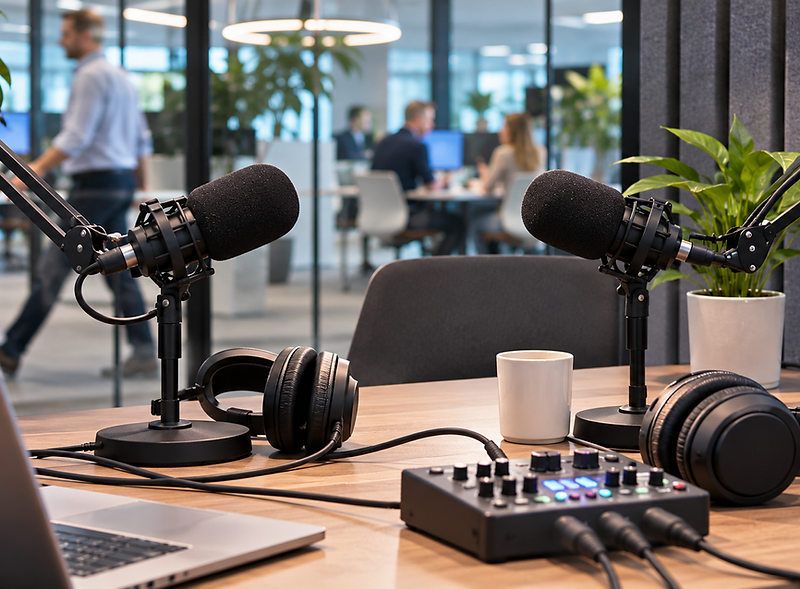
Which microphone setup works for a podcast in a noisy office?
Recording a podcast in an office means dealing with air conditioning, glass walls and background noise. This article explains which microphone choice, distance and simple acoustic measures isolate speech from ambient noise on location.
Recording a podcast in an office sounds simple: a few microphones, a quiet moment, done. But offices are rarely acoustically neutral. Air conditioning units hum, meeting rooms have glass walls that bounce sound around, and colleagues walk past in the background. Turning an office into a temporary studio means knowing which microphone setup actually separates speech from background noise, and which one does not.
Why an office sounds the way it does
An office space is built for work, not for recording. Hard floors, glass partitions and little soft furnishing create acoustic reflections: sound waves that bounce off hard surfaces and arrive at the microphone slightly delayed. That gives a recording a boomy, almost metallic character, even when the room seems quiet at the time of recording.
On top of that, there are continuous noise sources the human ear tunes out but a microphone does not: ventilation systems, servers, a fridge down the hall. That background noise builds up in the recording and is far harder to remove afterwards than to avoid at the source.
Choosing the right microphone: dynamic versus condenser
The type of microphone largely determines how much ambient noise ends up in the recording.
A condenser microphone is sensitive and captures subtle detail in a voice, an advantage in an acoustically treated studio. In an office, that same sensitivity becomes a drawback: it will pick up a keyboard clattering two desks away just as readily as the speaker's voice.
A dynamic microphone is less sensitive to faint, distant sounds, which often makes it the better choice on location. The microphone's polar pattern also matters, it describes the direction from which a microphone picks up sound best. A cardioid or supercardioid pattern mainly captures sound from the front and reduces sound from the sides and rear, which is exactly what isolates a speaker from what is happening around them.
Distance, direction and physical isolation
Even the right microphone performs poorly if it is too far from the mouth. The closer a microphone sits to the speaker, the greater the gap between the wanted signal and the background noise, a ratio audio engineers call the signal to noise ratio. In practice, a microphone placed twenty to thirty centimetres from the mouth often gives better results than one neatly kept out of shot a metre away.
Direction matters just as much: positioning the microphone so that the main noise source, such as an air conditioning unit or a door to the corridor, falls within the least sensitive zone of the polar pattern often makes more difference than expensive gear. Where possible, Visify brings small, movable acoustic panels or absorbent screens to on-location recordings, placed around the recording spot just enough to break up direct reflections from a glass wall or hard floor, without rearranging the entire space.
The best microphone solves nothing if the room itself is working against you.
Recording strategy: multiple channels, timing and room choice
A final, often underestimated factor is the recording strategy itself. Giving each speaker their own microphone and recording each signal on a separate channel, rather than mixing all voices into one track, gives far more control afterwards: noise picked up by one microphone can then be addressed on its own, without affecting another speaker's voice.
The choice of room within the office also matters: a smaller meeting room with some soft furnishing, bookshelves or an upholstered chair absorbs sound better than a large, bare open-plan area. Timing remains relevant too: recording when the room next door is empty or the cleaning team is not active avoids problems no microphone can fix afterwards. None of these choices require major changes to the office space, but they do call for some preparation before the record button is pressed.
Anyone who records podcasts in an office regularly notices that a fixed combination of microphone type, distance and a few mobile absorption panels eventually produces a predictable, repeatable result. That is exactly what organisations need when they want to use their office as a studio: not a full acoustic renovation, but a thought-through, reusable setup that delivers the same result every time.