
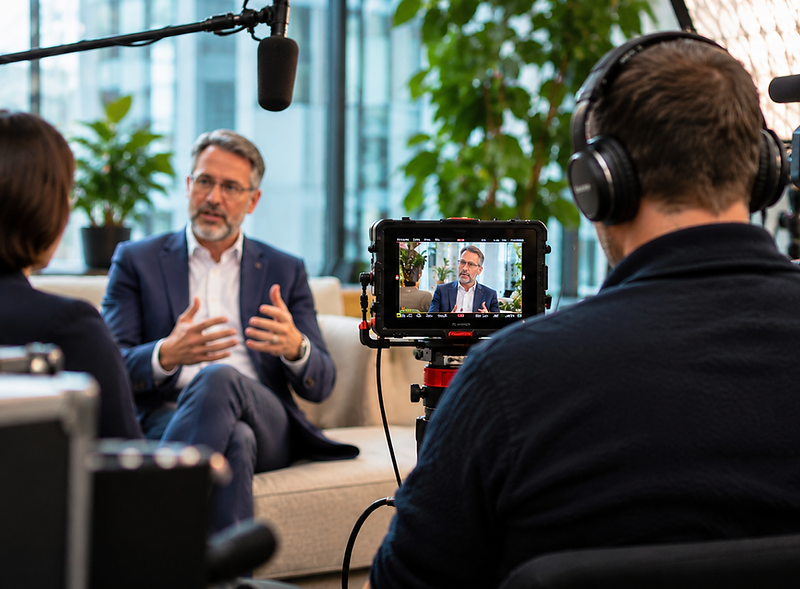
Good sound goes unnoticed. Bad sound never does.
Beautiful visuals can impress, but poor sound can ruin the entire viewing experience. Discover why acoustics, microphone placement and experienced sound engineers are just as important as cameras and lighting, and why even AI can't fix everything.
Beautiful visuals, perfect lighting and an impressive location. Everything looks just right. Until someone starts speaking and it sounds as though the recording was made in a bathroom. Sound is probably one of the most underestimated aspects of video production. And yet, it's also one of the most important.
Our eyes are more forgiving than our ears
A video doesn't always need to be perfectly sharp to hold someone's attention. A slightly imperfect camera angle or somewhat limited image quality doesn't necessarily ruin the viewing experience.
Sound is a different story.
A constant hum, distracting reverberation or a voice that's difficult to understand forces viewers to make an extra effort. They're no longer simply listening to what's being said. They're struggling to understand it. And as soon as listening becomes hard work, attention shifts away from the content.
That's why a simple video with clear sound is often more enjoyable to watch than a visually impressive production that constantly forces you to adjust the volume.
A good microphone doesn't solve everything
There's a persistent misconception that an expensive microphone automatically guarantees excellent sound. Unfortunately, if only it were that simple.
A microphone doesn't just capture the speaker's voice. It also picks up the environment around them. An empty meeting room with glass walls, a spacious entrance hall or a room with hard flooring may look fantastic on camera, but acoustically, they can be a small disaster.
Sound reflects off walls, ceilings and floors, creating reverberation that makes speech less intelligible. A professional microphone can help isolate the speaker's voice, but it cannot completely compensate for poor room acoustics.
That's why good sound recording doesn't begin with choosing a microphone. It begins with assessing the location.
The invisible guests at every recording
Anyone who regularly films on location knows them well: the sounds nobody notices until the recording starts. An air conditioning system humming continuously. A refrigerator suddenly switching on. Traffic outside. A lift behind the wall. Or an enthusiastic colleague who decides that the middle of an interview is the perfect moment to descale the coffee machine.
Our brains are remarkably good at filtering out familiar background noises. Microphones, not so much. What barely registers during a normal conversation can become incredibly distracting in a recording.
That's why a sound check before filming is essential. Not just to confirm that the microphone works, but more importantly, to listen to the environment.
Sometimes, temporarily switching off a device, choosing another room or moving the setup a few metres is enough.
Small adjustments can make a surprisingly big difference.
Sound deserves just as much preparation as the visuals
In video production, considerable thought often goes into the background, lighting and camera angles. And rightly so. But sound recording deserves exactly the same attention.
Where is the microphone positioned in relation to the speaker? Do they move around while talking? Are there multiple speakers? Is there background noise? And how do we monitor sound quality throughout the recording? A lavalier microphone, for example, can work perfectly for an interview, but become problematic when clothing constantly rubs against it.
A shotgun microphone can also be an excellent solution, provided it's positioned correctly. A microphone that's hidden outside the frame but placed too far from the speaker won't necessarily deliver better sound than a visible microphone positioned closer.
The right solution depends on the situation. Not on the price tag.
Good sound also requires the right people
Professional equipment matters, but ultimately, it's the people behind it who make the difference.
An experienced sound engineer often detects problems before anyone else notices them. They know when a microphone needs repositioning, recognise acoustic challenges and intervene when conditions change.
That's why Visify works exclusively with experienced professionals. Not just behind the cameras or in the control room, but also when it comes to sound. Because a great recording isn't a matter of luck. It's the result of expertise, preparation and attention to detail.
And sometimes, the most important technical decision is surprisingly simple: waiting a moment for the air conditioning to stop humming.
A lot can be fixed in post-production. But not everything.
Modern audio technology is impressive. Background noise can be reduced, voices can be enhanced and even troublesome reverberation can be partially corrected.
With artificial intelligence, these possibilities have expanded considerably in recent years. But there are limits.
When a voice is barely intelligible, several people are speaking at once or background noise overwhelms the recording, post-production cannot always deliver a natural-sounding result. Overly aggressive noise reduction can also make voices sound artificial. As if the speaker were underwater, or calling through a particularly bad telephone connection from 1998.
Post-production is a valuable tool. Not a miracle cure.
You don't notice good sound. You simply listen.
The best sound recording is often the one nobody comments on. The voice sounds natural, the volume remains comfortable and the message comes across clearly. Viewers don't have to think about the sound at all. They can focus entirely on the content. And that's ultimately the purpose of good audio production.
Not to impress people with microphones, mixing consoles or complicated technical terminology, but to make sure the message reaches its audience without distractions.
Because beautiful visuals capture attention. Great sound keeps people listening.