
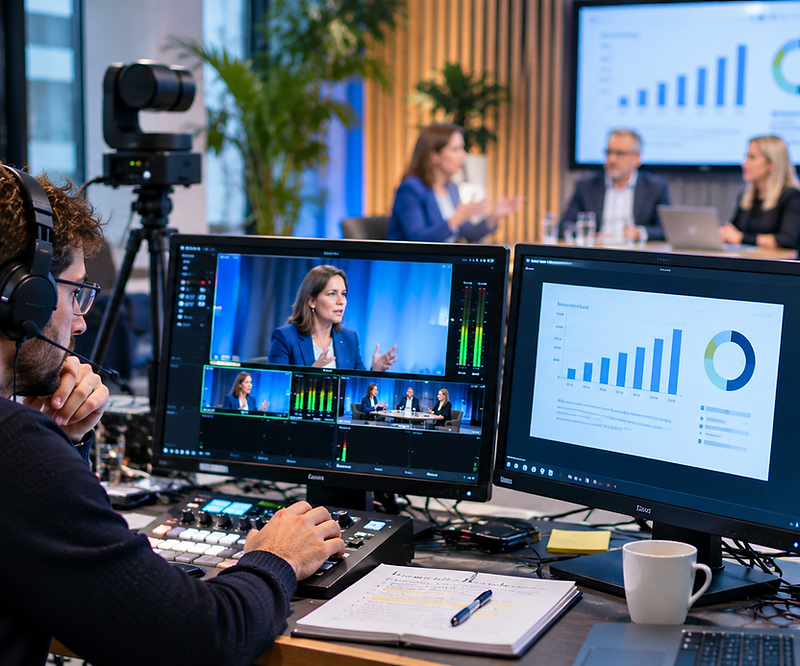
Four cameras and one operator. Does that automatically make it a professional video production?
Four cameras and one operator: modern technology has made compact multicamera productions more accessible than ever. But when is a simple recording sufficient, and when does an event require professional multicamera directing? Discover why the final result matters more than the number of cameras.
Four cameras, a compact control setup and one person operating everything. Today's technology makes it entirely possible. And often at a particularly attractive price. But do more cameras automatically mean a better production? And can one operator really keep an eye on everything at once? The answer is more nuanced than the number of cameras listed in a quotation might suggest.
Technology has made an enormous leap forward
Not so long ago, a multicamera production required a fairly extensive technical setup. Camera operators, a separate control room, cabling, monitors and several technicians, each with their own responsibilities.
Today, everything can be considerably more compact.
Modern PTZ cameras can be controlled remotely, video switchers fit into a backpack, and automated systems are taking over an increasing number of tasks. A single operator can control multiple cameras, switch between shots and record the production.
It's a remarkable development. Technology has made professional production equipment more accessible and lowered the barriers to recording events, training sessions and conferences. But there's an important distinction between what's technically possible and what's sensible from a production perspective.
Four cameras don't automatically make a good production
Imagine a scientific conference.
A speaker is presenting complex research findings. On stage, a discussion begins between three panellists. Meanwhile, a question comes from the audience, the presentation needs to appear correctly on screen, and the lighting changes as the next speaker takes the stage. At that moment, a great deal is happening simultaneously.
A good director anticipates. They know when to change camera angles, when to display a presentation full-screen and when a panellist's reaction is more interesting than the person currently speaking.
Four cameras offer possibilities. But someone still needs to use those possibilities intelligently. Otherwise, you end up with four camera angles and a great deal of uncertainty about which shot to choose. Good directing isn't simply about adding more cameras. It's a series of editorial and technical decisions that together create a coherent story.
One operator can do a lot. But not everything at once.
An experienced technician can handle an impressive number of tasks, particularly in a predictable production with a fixed setup, limited interaction and a clearly defined programme. There's absolutely nothing wrong with that. But every additional responsibility requires attention.
While an operator is controlling cameras, they may also need to monitor audio levels, follow presentations, supervise the recording and respond to unexpected situations.
What happens when a microphone fails just as the speaker unexpectedly deviates from their presentation? Or when a camera needs repositioning while someone in the audience asks a question? Technology can automate certain actions, but human attention remains a limited resource.
And that's precisely where the difference emerges between a compact recording setup and a production in which different disciplines receive dedicated attention. That doesn't mean every project needs five technicians. It simply means the crew should be matched to the complexity and risks of the production.
A recording isn't necessarily a finished programme
Another attractive argument for compact productions is the possibility of delivering a complete recording immediately after the event. And indeed, when a programme is properly switched and recorded live, a usable master can be available as soon as the production ends. For certain applications, that's exactly what's needed.
But an immediately available recording isn't automatically a finished production. Perhaps a presentation needs to be integrated more clearly in post-production. Maybe an awkward transition needs correcting, unwanted noise needs removing, or a discussion needs to be divided into individual chapters.
For scientific and medical content, this post-production work can be particularly relevant. Graphs, research findings and detailed slides must remain clearly readable when the recording is watched afterwards. A live-switched recording can be excellent. But it doesn't always offer the same correction possibilities as a production in which individual camera feeds and audio sources are recorded separately.
The difference isn't necessarily in the quality of the original recording, but in the flexibility available afterwards.
Affordable and efficient aren't the same thing
A compact production with one operator generally has lower staffing costs than a larger multicamera production. That's perfectly logical. And for certain projects, this approach is also the most sensible economic choice.
But the cheapest quotation isn't automatically the most efficient solution.
If a recording turns out to be insufficiently usable, important shots are missing or technical problems weren't detected in time, the initial savings can quickly disappear.
That's why it's essential to determine in advance what the recording needs to achieve.
Is it a simple recording for internal use? A complete conference recording that will later be published online? An accredited medical training session? Or a professional broadcast for a large audience? These are different assignments, with different expectations and technical requirements.
A delivery van and a truck can both transport goods. But nobody expects them to handle exactly the same job under every circumstance.
The right production starts with the right questions
At Visify, we don't believe that every production automatically requires a large technical crew. We do believe that every production deserves a carefully considered approach, delivered by experienced professionals.
Sometimes, a compact setup is perfectly sufficient. In other situations, a conference calls for multiple camera operators, a dedicated sound engineer and a director who can focus entirely on the visual production. The decision should be based on the content, location, expectations and intended use of the footage.
Not on a standard package where the number of cameras has already been decided before anyone has even looked at the programme. Because ultimately, a client isn't buying four cameras, a video switcher or a certain number of technicians.
They're expecting a reliable production and footage that achieves its purpose. And that result is difficult to measure by counting the cameras listed in a quotation.