
A livestream without a Plan B isn't much of a plan.
Even a perfectly prepared livestream can encounter unexpected technical problems. Discover why backup connections, redundancy, technical rehearsals and experienced professionals are essential for a reliable broadcast. Because a good plan also prepares for what could go wrong.
The cameras are ready, the speakers are prepared, and the first participants are logging in. Everything is working perfectly. Until, five minutes into the broadcast, the internet connection suddenly drops. Now what? In professional livestreaming, the most important question isn't just how to get everything up and running, but what happens when something stops working.
Technology fails. That's not pessimism.
Anyone who regularly produces livestreams knows that technical problems can never be completely ruled out. An internet connection can fail. A computer can freeze. A microphone can suddenly stop transmitting a signal. Even equipment that worked flawlessly during the technical rehearsal can unexpectedly develop problems during a broadcast.
That doesn't necessarily mean someone has done a poor job. It simply means that technology, however professional, is never one hundred percent predictable. The difference between an amateur and a professional production therefore isn't a promise that nothing will ever go wrong. It's being prepared for the moment when something actually does.
One internet connection is not a backup strategy
A stable internet connection is essential for livestreaming. But a fast connection isn't automatically a reliable one. An impressive speed test tells you very little about what happens when that connection suddenly disappears.
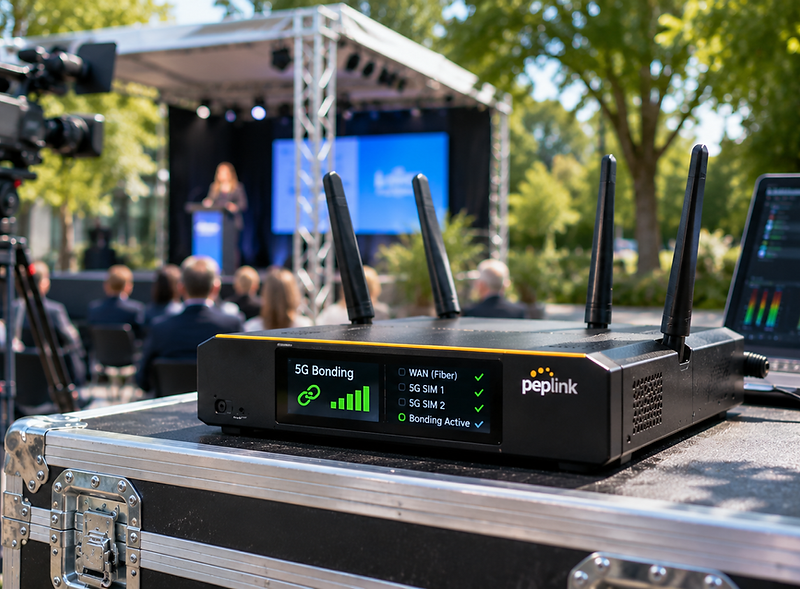
That's why, at Visify, we don't just look at the available bandwidth. We also assess the possibilities for an independent backup connection. This could be a second fixed internet connection or a mobile connection using 4G or 5G. The important thing is that the backup doesn't depend on exactly the same infrastructure as the primary connection.
Connecting two network cables to the same router might look reassuring, but if that router fails, you're essentially left with two cables and no internet. And a backup connection that's never been tested is really just wishful thinking.
Redundancy is about more than having a spare device
A backup computer or a second video switcher can certainly be useful. But redundancy goes much further than simply duplicating equipment. It's about understanding which elements of the production are critical and what happens when one of them fails. What if the presentation computer freezes? What if the audio connection to the streaming platform is interrupted? What if the primary encoder suddenly stops broadcasting?
For every critical component, an alternative solution should be identified in advance. Sometimes that means a second device. Sometimes it's an alternative signal path. And sometimes it's a clear procedure that allows a technician to intervene within seconds.
Not every event requires a completely duplicated technical setup. But the risks should always be assessed deliberately. Because having redundant equipment without a clear switchover procedure is a bit like carrying a spare tyre without knowing where the jack is.
A technical rehearsal is not just a formality
A proper technical rehearsal involves much more than quickly checking whether there's picture and sound. It's the moment when the entire production chain is tested. Cameras, microphones, presentations, internet connections, streaming platforms and communication between technicians all need to work together exactly as they will during the actual broadcast.
The speakers also deserve attention. Do they know when they'll appear on screen? How will presentations be controlled? What happens if someone unexpectedly becomes unavailable or joins late?
For medical and scientific webinars, this preparation is particularly important. A complex presentation, an international speaker joining remotely or a live discussion between several specialists leaves little room for improvisation. A rehearsal isn't just about confirming that everything works. It's also about discovering what might not work, while there's still time to fix it.
When things go wrong, experience makes the difference
A technical problem during a livestream often causes more stress behind the scenes than it does for the viewers. At least, when the production crew knows what they're doing.
An experienced technician quickly recognises irregularities, understands the possible causes and knows which actions should take priority. That's why Visify works exclusively with experienced professionals who don't just know how to operate equipment, but also understand how the entire production works together. That makes a significant difference.
Because when the sound suddenly disappears during a broadcast, there's no time to calmly download an instruction manual. Someone needs to know where to look, what to check and how to restore the broadcast as quickly as possible.
Reliability is no coincidence
A professional livestream is the result of dozens of decisions the audience will never see. The choice of connections. The technical preparation. Signal monitoring. Agreements between technicians. Backup scenarios. When everything runs smoothly, viewers won't notice any of it. And that's exactly the point.
At Visify, we don't consider technical reliability an optional extra on a quotation. We see it as an essential part of the production. That doesn't mean every event requires the same technical setup. A simple internal webinar has different requirements from an international medical conference with hundreds of participants. But the responsibility remains the same: anticipate what could go wrong and prepare the production accordingly.
Starting a livestream is one thing. Keeping it running, even when technology decides not to cooperate, is where professionalism truly makes the difference.