
A hybrid event has two audiences. Treat them that way.
A hybrid event brings together two audiences with different expectations. How do you make sure remote participants feel genuinely involved rather than simply watching from a distance? A look at interaction, production and designing a programme that works for everyone.
A speaker on stage, an audience in the room and participants joining remotely. On paper, it sounds simple: add a livestream and you have a hybrid event. In practice, it's far more complex. Because what works perfectly for the audience in the room doesn't necessarily create a good experience for those attending online.
Two audiences, two different experiences
Attending an event in person is about much more than watching a presentation. There's the atmosphere in the room, conversations with other attendees, interaction with the speaker and everything happening around the programme.
For remote participants, much of that experience disappears. They depend entirely on what they can see on screen and hear through their speakers. A presenter pointing to someone in the audience, a question from the room that can't be heard or a presentation with text that's too small to read: small details can make a significant difference online.
And yet, event planning often focuses primarily on the people in the room. The livestream is organised from a technical perspective, while the experience of the online audience receives far less attention.
Online participants are not a secondary audience
One of the biggest challenges of hybrid events is interaction. In the room, an attendee can spontaneously ask a question. The speaker sees the audience's reactions and can respond accordingly. Online, that interaction is much less natural. Especially when only questions from the room are addressed, remote participants can quickly feel disconnected.
But it doesn't have to be that way.
With a dedicated moderator, questions from online participants can become just as much a part of the programme as those from the room. Polls can be accessible to both audiences, and presenters can make a conscious effort to address the people watching remotely. The key is to plan that interaction in advance. Adding a chat feature to a streaming platform is easy. Making sure questions actually reach the speaker requires organisation.
Interaction doesn't happen simply because the technology is available. It happens because someone deliberately makes room for it during the event.
Production needs to look beyond the stage
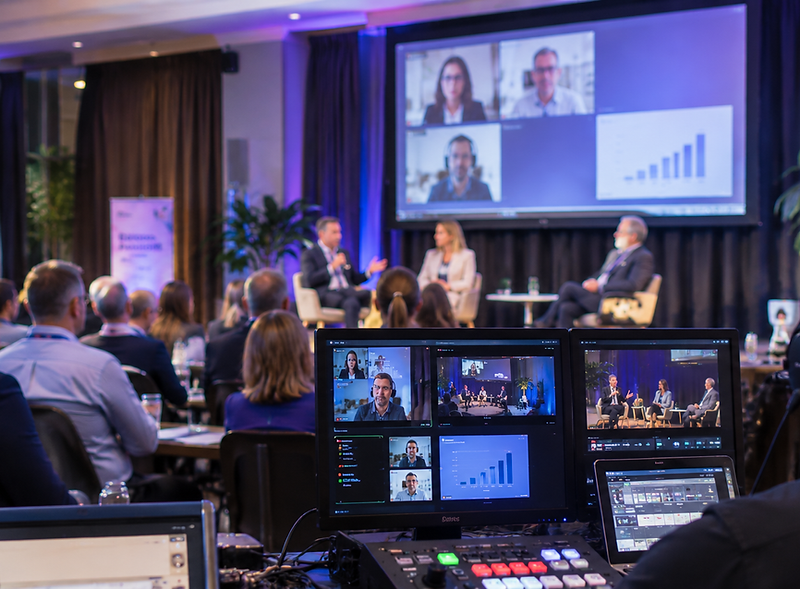
From a technical perspective, hybrid events also require different decisions. In the room, attendees can choose whether to look at the speaker, the presentation screen or other participants. Online, the video director decides what viewers see. A single fixed wide shot of the stage is therefore rarely enough. Sometimes viewers need to see the speaker, sometimes the presentation and sometimes a combination of both. Questions from the room must also be clearly audible to the online audience.
But directing a hybrid event involves more than switching cameras. It's also about timing. What happens online during a break? What do viewers see while the stage is being prepared? And how is a technical interruption handled? A well-produced hybrid event considers both audiences, even when very little is happening on stage.
One event doesn't necessarily mean one programme
A common misconception is that online participants should see exactly the same thing as the people in the room. That's not always necessary. During a networking session, the in-person audience might be meeting and talking with other attendees, while online participants follow a short additional session. A break in the room could be used online for an interview, a recap or practical information.
Even during presentations, the approach can differ. A chart that's perfectly readable on a large projection screen may be better shown full-screen to remote viewers. A discussion with the audience requires a different approach to make sure everyone can follow it. This doesn't mean organising two entirely separate events. It simply means considering the experience of both audiences for every part of the programme.
Hybrid starts with preparation
A hybrid event is more than an in-person event with a camera added. It requires a programme that includes both audiences, a technical production that supports their different experiences and a production team that constantly considers what's happening both in the room and online.
That's why the decision to make an event hybrid should be part of the content planning from the beginning, rather than something discussed only when audiovisual requirements come up. Because ultimately, the goal isn't for everyone to see exactly the same picture.
The goal is for everyone, wherever they are, to feel genuinely involved.